An instructor here is a steward of something larger than themselves. The relationship between teacher and student carries real weight, in both directions. Teaching is not demonstration for admiration. It is transmission with responsibility, and that responsibility runs in every direction: to the student, to the art, and to those who carried it here.

Edwin Rodriguez
The Founder of Rinkiohen-Do
Edwin Rodriguez began martial training at age seven, first in boxing and Judo, developing early familiarity with contact, timing, and the realities of applied fighting. He later studied Shotokan Karate, broadening his technical range. From youth he was known for a naturally combative temperament and a willingness to test himself, both in formal training and in the informal exchanges that shaped serious practitioners of his generation.
In his teenage years he encountered a group training in Mas Oyama's Kyokushinkai Karate, whose full-contact ethic and uncompromising method became a central formative influence. Through years of training and fighting he developed a reputation not only as a powerful fighter but as a highly technical one, someone whose effectiveness came from timing, judgment, and the ability to express technique under real pressure. That emphasis on functional skill over appearance would remain a defining mark of his martial character.
In time, Edwin came into association with a group of skilled instructors drawn from Shaolin Kempo, Japanese Jujutsu, Gōjū-ryū, and other karate lineages. Their purpose was not to collect styles but to challenge assumptions, compare methods, and identify what held up under contact and testing. Over time Edwin became the central figure of that group, and its focus shifted from style-to-style exchange toward a systematic study of the principles that made skill possible across styles: balance, distance, timing, perception, and the ability to respond correctly under changing conditions.
When Edwin moved to the United States he continued carrying forward the methods distilled through those years of work and raised his only son, Kerwin Rodriguez, within that evolving tradition. In 2000 the art was formally named Rinkiohen-Do with his approval. On April 4, 2026, he formally transferred the Sōke office and lineage to Kerwin Rodriguez via Yuzurijō.
Current Sōke
Kerwin Rodriguez is the current Sōke of Rinkiohen-Do, having received the Yuzurijō from Edwin Rodriguez on April 4, 2026. He was trained from youth within the tradition, developing deep technical grounding alongside more than thirty years of broader martial experience across multiple systems.
He is responsible for the later philosophical articulation of the system, integrating studies in yoga, Mikkyō, and Taoist internal cultivation into the school's developing internal identity, and giving shape to the conceptual framework through which the art is now understood and taught.
His professional background spans martial instruction (including police academy training), executive protection (including security for public figures), crisis management instruction, behavioral therapy, and mindfulness-related disciplines. This breadth informs an approach to instruction that is technically grounded, psychologically aware, and oriented toward practical application.
Kerwin Rodriguez
Instructors who have trained directly under the current Sōke and carry the tradition forward in their own practice.

Robert Metz
Instructor
Robert Metz is an instructor of Rinkiohen-Do, bringing more than 35 years of martial arts experience and a distinguished military career to his practice and teaching.
He is a retired U.S. Army Sergeant Major with 22 years of service, having served as a Senior TAC NCOIC at the U.S. Army Ranger School and as co-founder of the Army's Gun Truck Alley initiative. He brings 30 years of experience in program development and post-secondary education, having created curricula across academia, the private sector, military institutions, and law enforcement.
His martial background encompasses a wide range of systems, with particular depth in Filipino martial arts, American Kenpo, grappling disciplines, and military combatives. His therapeutic certifications add a unique clinical dimension to his instruction and bodywork.
How This Tradition Teaches
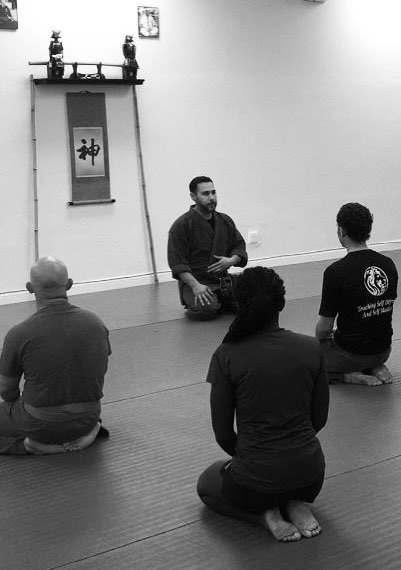
Instruction in Rinkiohen-Do is transmission, not performance. The teacher is accountable for what is passed on, and the student is responsible for how it is received. Neither role is entered into lightly.
The curriculum includes both outer technical training and inner developmental work. An instructor must be capable and honest in both.
Technically Capable
Deep functional mastery of the art's body method across all ranges.
Strategically Perceptive
Ability to read situations and respond without rigid reliance on predetermined patterns.
Psychologically Steady
Calm under pressure. Not rattled by adversity. Regulated in action.
Ethically Responsible
Aware of the duty that comes with transmitting an art that affects others.
Principled in Transmission
Able to pass on understanding, not only technique. The student develops clarity, not imitation.
Committed to Development
An instructor's own training does not stop when they begin to teach. Growth and honest self-assessment are expected at every level.
Inquiries about training, instruction, or the tradition itself are welcomed through the dojo contact page.